



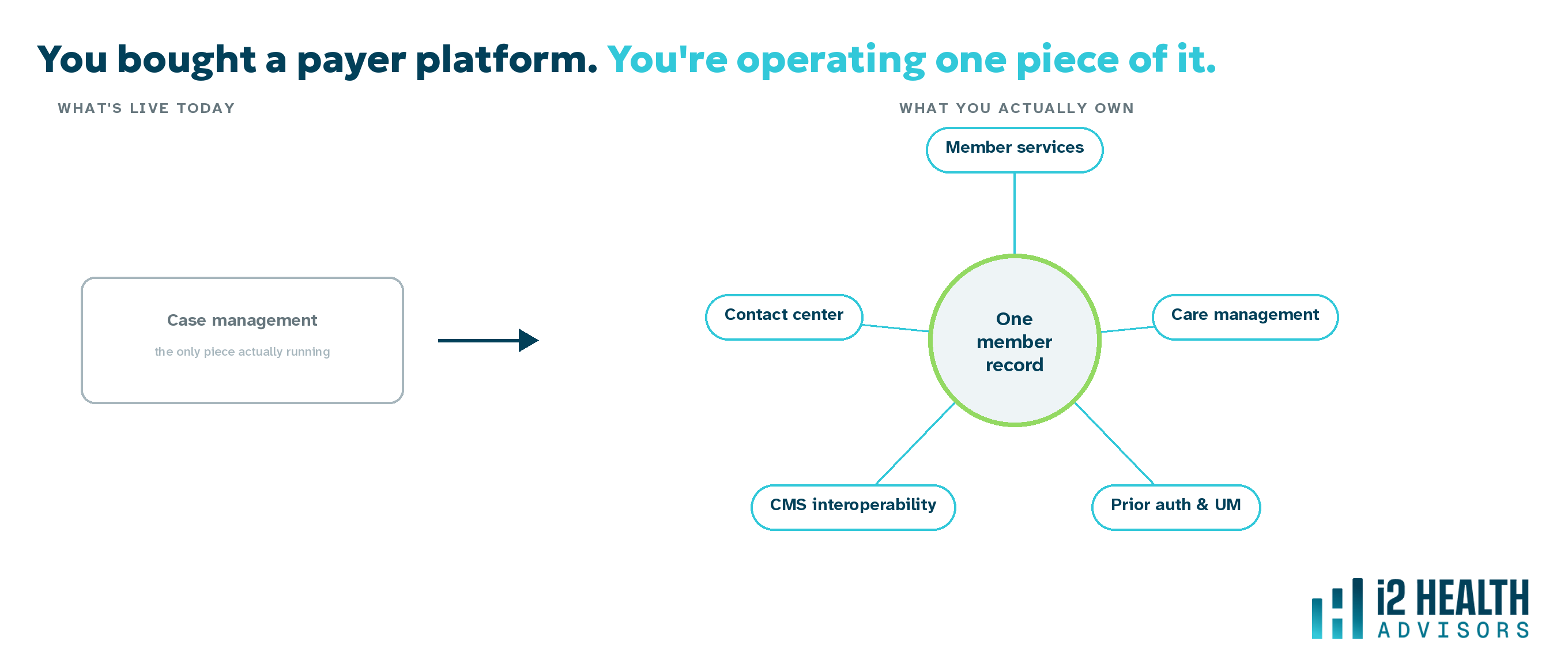
That platform is built to run member services, care management, prior authorization, and CMS interoperability from a single record. Administrative costs keep climbing. Member experience scores keep slipping. The parts of Health Cloud built to fix both sit dark.
Here's what that costs you, and where the opportunity actually is.
The Data Model Is the Asset
Before we talk about AI, let's talk about what makes Salesforce actually powerful for payers: its ability to create a single, actionable member record that connects across lines of business, touchpoints, and workflows.
Health plans are drowning in data that can't talk to each other. Claims systems, care management platforms, member portals, and call center tools all live in separate silos. What Salesforce does when implemented well is create the connective tissue: member demographics, care gaps, authorization history, open cases, and call transcripts surfaced in one place, in real time, to whoever needs them.
Health Cloud handles that connecting on its own for most payer use cases. Plans that want to fold in deeper or less structured data (claims history at scale, call transcripts, scanned documents) pair it with Data 360, Salesforce's data platform, formerly Data Cloud, which sits underneath Health Cloud and extends the same member record. Either way, the record comes first.
That's the foundation for everything else.
Agentforce for Health Is Worth Watching, But Read the Fine Print
In March 2025, Salesforce announced Agentforce for Health: a library of pre-built AI agent skills targeting eligibility verification, prior authorization, benefits checks, and care coordination, with integrations to athenahealth, Availity, and Infinitus.ai. In March 2026, they followed up with six new agents for providers and payers, adding integrations with HealthEx, Verily, and Viz.ai.
One naming note: Salesforce now markets Health Cloud itself under the Agentforce umbrella as "Agentforce Health." The product, the healthcare data model, and the licensing haven't changed, and Salesforce's own pricing pages still run on "Health Cloud." We're sticking with Health Cloud here since that's still what your team searches for, licenses, and configures.
The pitch is compelling: real-time prior auth decisions, automated eligibility checks, AI-assisted documentation, and contact center agents with a full member summary before the call even starts.
The honest take: the technology is further along than the data. At plan after plan, the underlying member data model is a mess, and you can't put an AI agent on top of incomplete, inconsistent data and expect it to perform. Garbage in, garbage out. Just at scale now, with a chatbot in front of it.
The plans that will get value out of Agentforce are the ones that did the unglamorous data work first. This is the same challenge facing every self-service AI tool entering health plan operations. For more on governing that shift, see Everyone Can Build. Now What?.

The Platform Is Running, Here's What Isn't.
We see this pattern regularly. A health plan is live on Salesforce Health Cloud, using it for member case management, with the platform running and the licenses paid. And then:
- Care management teams are still working out of spreadsheets because the Salesforce workflows weren't built for their process.
- The call center has Salesforce open alongside three other systems because the screen layout wasn't configured to surface the right information.
- Reporting requires a manual export to Excel because nobody built the dashboards.
- The Einstein or Agentforce features are turned off (or turned on but untrained) because there was no post-go-live optimization.
These are failures of implementation depth and ongoing investment. Salesforce requires configuration, iteration, and someone who actually understands both the platform and the payer operational context. It is not a deploy-and-walk-away platform.
Where the Real ROI Lives
For health plans specifically, the highest-value use cases we see are:
Member services and contact center. When an agent has a complete member record (open cases, recent claims, care gaps, prior auth status) before the call starts, handle time drops and first-call resolution goes up.
Care management workflows. Embedded HEDIS gap tracking, care plan documentation, and outreach management inside the platform where care managers already work reduces toggle fatigue and improves documentation completeness.
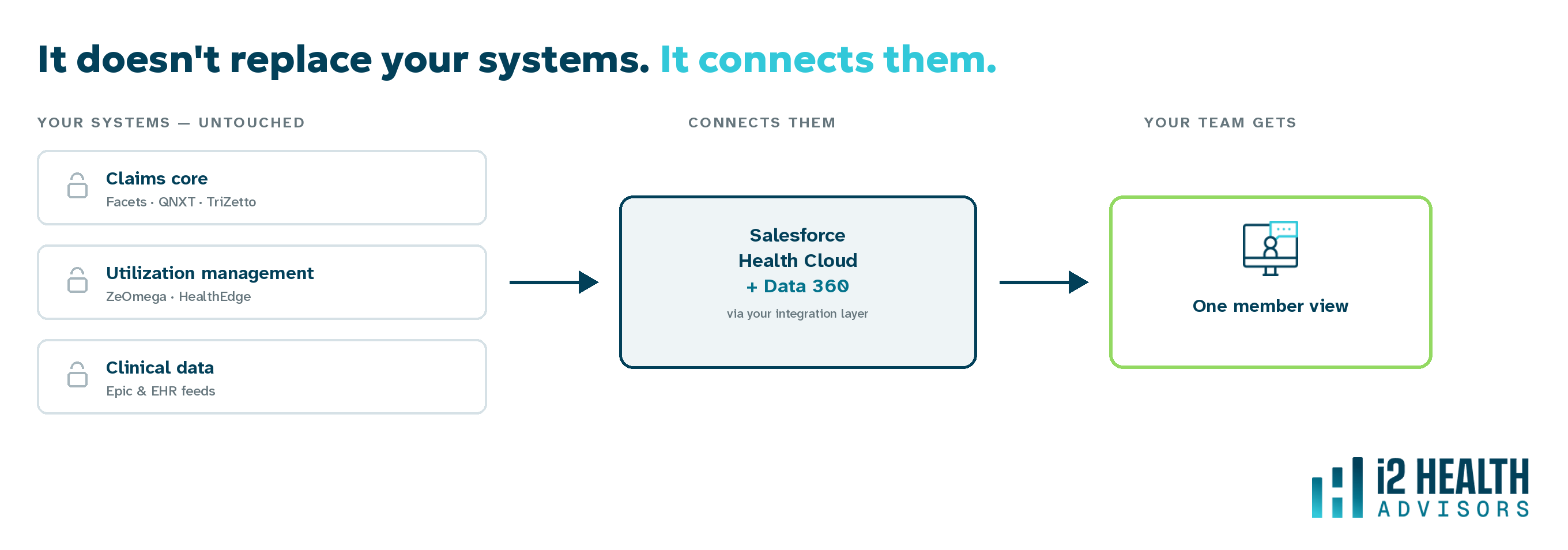
Prior authorization and utilization management. Pull real-time auth status out of your UM platform (ZeOmega, HealthEdge) or payer core system and into Health Cloud, and you cut the manual back-and-forth between reps and care managers that's costing everyone.
Interoperability and CMS compliance. You don't have to rip and replace your core systems. You need a middleware layer that translates between them and Health Cloud. MuleSoft is Salesforce's own option and the one we reach for most often, but it's one of several ways to meet CMS data-sharing requirements without rebuilding your core systems.
What This Means For You
Salesforce made a meaningful bet on healthcare, and Agentforce for Health is evidence they're not backing off it. The health plans that benefit most won't be the ones who buy the newest features first. They'll be the ones who built a real foundation (clean data, thoughtful configuration, workflows that match how their teams actually operate) and then layered capability on top of it.
If your Salesforce environment feels like it's underperforming, it probably is. The cause is almost always the same: the data foundation wasn't built right, and the workflows weren't configured for how your teams actually work.
That's fixable. Let us show you where.
Start with a Salesforce Health Cloud assessment →
i2 Health helps health plans build and operate Salesforce Health Cloud the right way: starting with the foundation, through to AI readiness and optimization.
Frequently Asked Questions
Q: We already paid an implementation partner to set up Salesforce Health Cloud. Why are we still only using it for case management?
Because your implementation partner did exactly what they were hired to do, then moved on. They're scoped and measured on one thing: go-live. They build what's in the statement of work, which is almost always case management first, hand over the keys, and roll to the next client. Nothing in that contract covered member services, care management, prior auth, or interoperability, so none of it got built. Getting to the rest of the platform's value takes someone coming back after go-live to configure those workflows and expand scope as your team is ready for more. That's a different engagement than the one you paid for, and it's usually the one that gets skipped.
Q: How does Salesforce Health Cloud fit into our prior auth workflow without replacing our UM platform?
It doesn't replace it. It wraps it. Clinical determinations stay in ZeOmega, HealthEdge, or Epic, and Health Cloud pulls real-time auth status in directly so your reps and care managers see it without opening a second system.
Q: How long does it take to go from case-management-only to actually using the platform?
It depends on how much integration debt you're carrying. If your core systems already talk to each other, member services and care management can be live within a quarter. If they don't, the integration work takes longer than the configuration itself. The sequence matters more than the timeline: connect the data first, configure the workflows second, turn on Einstein or Agentforce last. Skip that order and you've found the fastest way to waste the project.