


The gap between spending on AI and getting results
Most health plans are spending on AI, but few are seeing returns. A 2026 Enterprise AI Study found that across industries, 76% of organizations believe they're ahead of competitors, but only 10% qualify as leaders with company-wide integration and measurable ROI. Health plans are no exception. The gap isn't the technology, it's whether payer operations expertise was in the room when the build decisions got made.
Two things are true at once right now. AI adoption at health plans is accelerating, and the technology has never been more accessible. A capable model is an API call away, and you no longer need a data science team to stand up a working bot. What hasn't caught up is the expertise around the build. Most AI experts available to health plans today are technology experts. Very few are health plan and technology experts, because that muscle hasn't been built yet. The industry simply hasn't had enough years of payer operators and AI builders working the same problems side by side.
That gap shows up in predictable ways. Plans build AI that is technically flawless but operationally blind. They deploy it at the wrong level of autonomy, or roll out tools nobody on the front line trusts, or scale before the data and governance infrastructure underneath it can support the load.
When the AI Works and the Operation Breaks
Here's an illustrative example. It's a composite of a pattern showing up in claims processing right now, walked through step by step so you can see where the process breaks. The specifics will differ at your plan: different thresholds, different pend mix, different systems. The mechanics of the failure won't. One of the most common reasons a claim pends at a health plan is that the billing provider's NPI (National Provider Identifier) doesn't match specific data requirements in the health plan's provider data management system. Health plan auto-adjudication rates range between 70-90%, meaning 10-30% of claims require some sort of manual review, with the majority requiring researching the NPI, contacting the provider, collecting enrollment documents, creating the record, and triggering readjudication. Assuming manual resolution of a pended claim has an average cost of $20, costs for these claims can quickly add up in addition to potential interest and/or penalties for delayed payment processing.
Let's consider addressing this common NPI mismatch issue. A health plan builds an AI bot to replace the manual review process. From a technical perspective, the build is excellent. In under four seconds the bot queries the NPPES national provider registry, cross-references the plan's internal provider data, validates the billing entity's tax ID against an identified parent group, confirms matching specialty taxonomy, and produces a confidence score for the provider match. At 95% confidence or above, the bot automatically creates a new provider or location record, inherits the parent group's contract terms, links the claim, and queues it for payment. No manual review required. Run at scale, the health plan has significantly eliminated manual resolution of pended claims, cut processing time, and pays providers faster. By every metric on the dashboard, the bot is working.
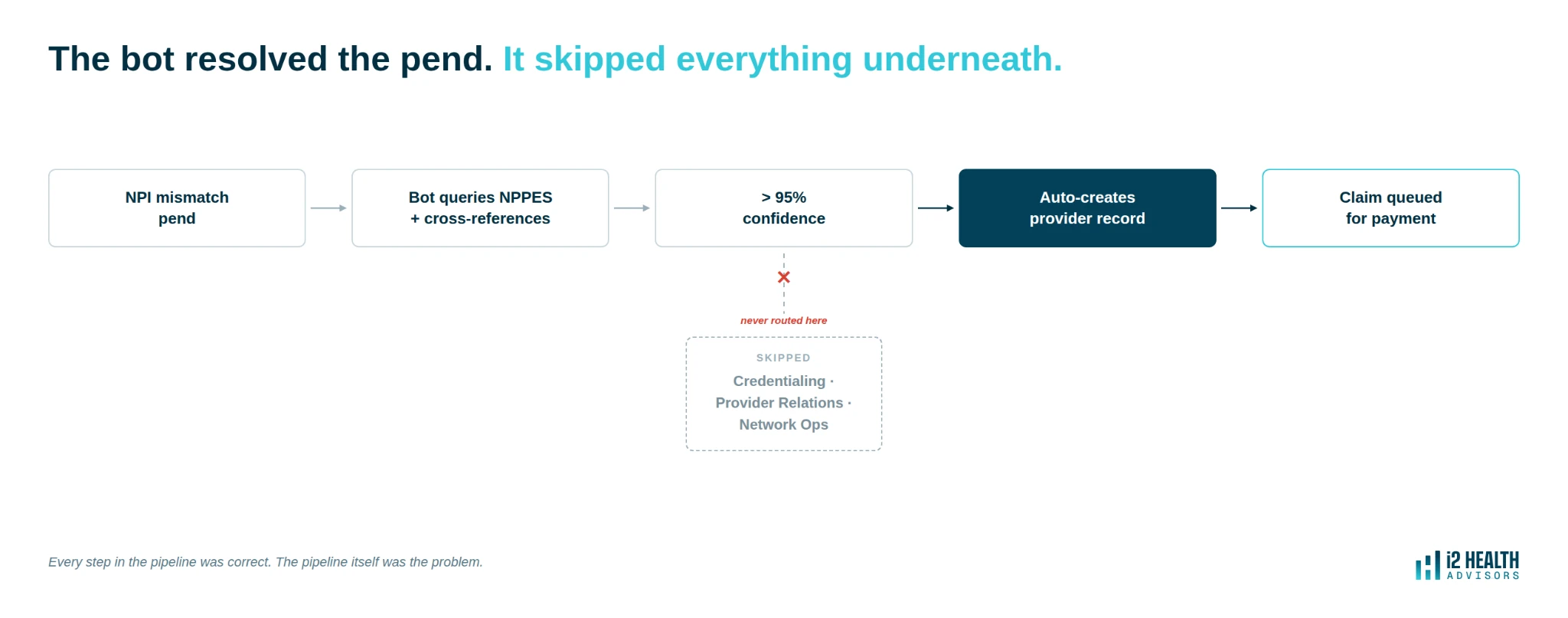
What the dashboard doesn't show is this: every auto-created record is a provisional entry, built outside the plan's provider enrollment and credentialing workflow. That workflow exists to verify a new location before it's treated as contracted and to keep one authoritative source of truth for provider data. The bot never asked whether Provider Relations, Network Operations, or Credentialing had ever seen this clinic location. It asked whether the NPI, TIN, and confidence score cleared a threshold. Some provisional records will get properly credentialed inside the plan's credentialing window. Some won't, and they'll sit unreconciled, feeding the same duplicate-record and directory-accuracy problems that show up in network adequacy audits and No Surprises Act reviews. The AI didn't invent the plan's provider data problem. It built a faster, automatic on-ramp to it, hundreds of times a month, with an audit log that says every individual step was correct.
Why technically flawless AI fails in health plan operations
An AI consultant can answer one question accurately and fast: can this model resolve X. In the NPI example, the honest answer was yes. What they can't evaluate is what a new provider record actually is inside this payer: the entry point to credentialing, contracting, network adequacy reporting, and directory accuracy obligations, Provider Relations, Network Operations, Credentialing, each with its own standards. Payer systems knowledge is what tells you "record created" isn't a self-contained action. It triggers downstream events in claims, the provider directory, and network reporting. Without both payer operations and systems knowledge, there's no way to know that auto-creating a record is a governance decision, not just a technical one.
This isn't about competence. An AI consultant doesn't know a credentialing workflow exists, that provider data has a designated owner, or that "record created" is a trigger word for processes they've never heard of. They design a technically excellent answer to the problem as stated to them (resolve the pend, verify the match, clear the claim) because that's the whole of the problem as they understand it. Whether a record should be auto-created at all is a payer operations and systems question. If no one in the room asks it, the build ships unaware of what it just bypassed. That's the difference between building something and building the right thing, and it only shows up when someone who understands end-to-end health plan operations is part of the conversation.
Three places this goes wrong without payer expertise in the room
The NPI bot looked correct at every layer it could see. The layers it could not see are where the damage compounds.
- Payer data. A confident match on NPI, TIN, and taxonomy confirms an entity exists. It doesn't confirm the location has been contracted, site-verified, or cleared for network adequacy.
- Payer operations. Automating the resolution removed the credentialing checkpoint entirely, instead of routing cases to it faster. The model's confidence score substituted for the judgment of the team accountable for that decision.
- Payer systems. The new record becomes a second, faster-moving source of truth for provider identity, alongside whatever governance process the plan already maintains. That multiplies rather than resolves the duplicate-record problem the plan was already fighting.
What flawless and right looks like
The fix isn't slower AI. Same technical build, redirected by someone in the room asking what the AI experts didn't know to ask: what does creating a provider record touch downstream, and who owns that decision today? Payer operations expertise flags that Provider Relations, Network Operations, and Credentialing each have a stake, and that "provisional" isn't "resolved." Payer systems expertise maps where a new record propagates (the directory, network adequacy reporting, every downstream system that treats it as authoritative) before the bot is built, not after an audit flags it.
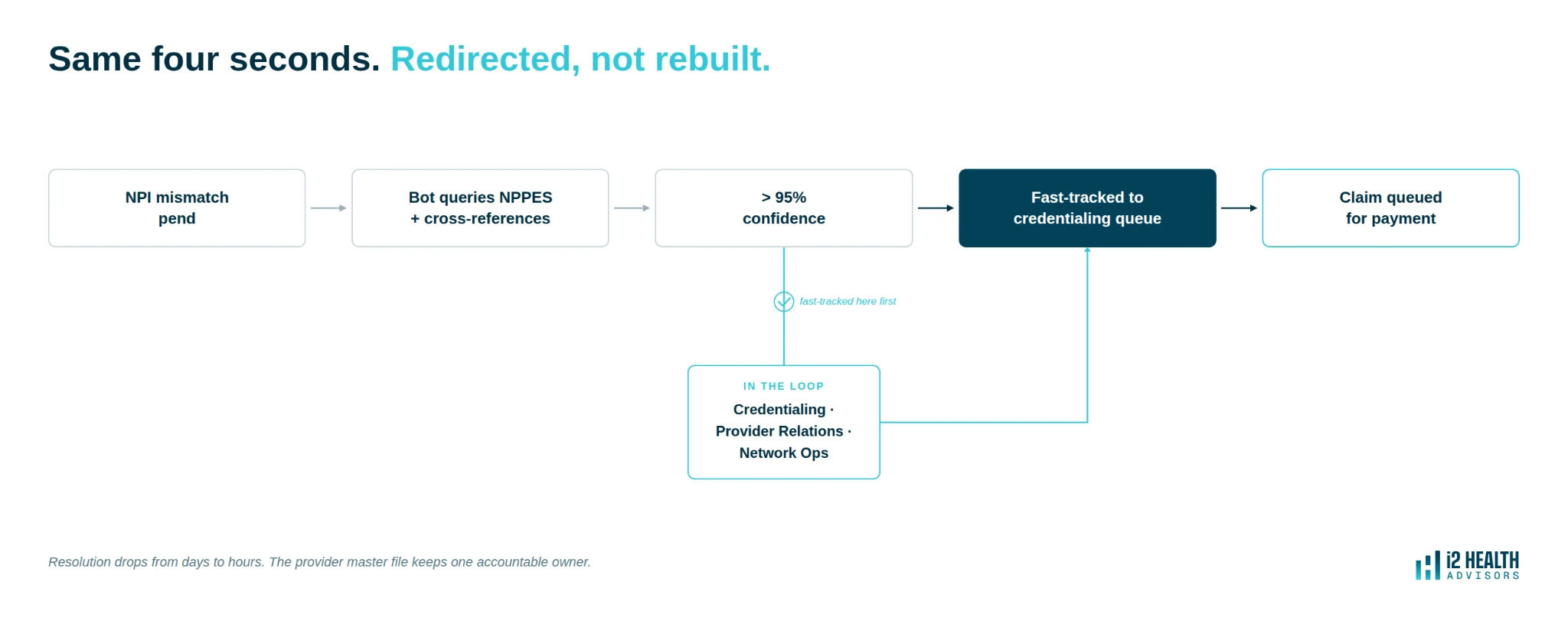
With those answers in hand, the build is redirected, not rebuilt. The same four-second NPPES-and-TIN check runs exactly as designed, but a high-confidence match becomes a fast-tracked input to the credentialing queue instead of an automatic record creation. Resolution time drops from days to hours. Labor costs still drop sharply. Providers still get paid fast. The difference is that Provider Relations, Network Operations, or Credentialing stays the accountable owner of the provider master file, and the efficiency gain doesn't arrive with a compounding data-quality bill attached. Nothing about the AI got slower. What changed is that someone who understood the operation was in the room early enough to decide what the model should do on its own and what it should only recommend.
Deloitte's research supports the instinct behind the original build: early adopters managing an entire case with AI, not just a single step, report more than twice the cost savings of organizations using narrower point solutions. The NPI bot was reaching for that kind of scope. It just didn't have the payer domain knowledge in the room to do it safely.
The calibration question
A flawless model is not the same thing as a flawless decision about what it should be allowed to do unsupervised. Once payer operations, data, and systems expertise sits alongside AI expertise as a matter of course, the question changes. It's no longer "what else can we automate." It's where on the spectrum between full autonomy and human-in-the-loop your AI actually belongs. Most plans get that calibration wrong in a predictable way.
Not sure where your AI builds stand on the spectrum between flawless and right?
Start with an AI readiness assessment →
Frequently Asked Questions
Q: Does adding payer operations expertise to AI builds slow down development?
The NPI bot in this article didn't get rebuilt, it got redirected. The same four-second NPPES-and-TIN check runs the way it always did. The only thing that changed is where a high-confidence match lands: into the credentialing queue instead of straight to a new provider record. That redirect didn't add time to the build. What adds time is spending months after launch unwinding governance and data-quality problems that someone with payer operations experience would have flagged in the first week.
Q: Can an AI workflow deliver real cost savings without creating downstream compliance risk?
It can, but the build has to account for how the operation actually runs, not just how the model scores on accuracy. The NPI bot cut labor costs meaningfully, which looked like a clean win until you followed the records it created. Those provisional entries bypassed the plan's credentialing workflow entirely, compounding the same data-quality and directory-accuracy problems that surface during network adequacy reviews. The savings were real. The risk accumulating underneath them was also real, and it grew every month the bot ran. Whether you get one without the other depends on whether the people who understand your payer operations, data governance, and downstream systems are in the room when build decisions get made, not called in after something breaks.